<p>Edgar Degas was a 19th-century French painter and sculptor known for depicting realistic movement. His chosen subjects were typically women and, in particular, ballet dancers. Degas's oil paintings and pastels remain some of the most breathtaking examples of Impressionism from the era.<p> <p class="title-3">Who was Edgar Degas?</p> <p>Edgar Degas was born into a wealthy Parisian family in 1834. As a classically trained artist, his early works focused on historical subject matter and traditional portraits. However, by the 1860s, he had forged relationships with luminaries like Edouard Manet, Claude Monet, and Pierre-Auguste Renoir.<p> <p>These friendships would profoundly impact his work, and by the 1870s, he was ensconced in the Impressionist movement and a key part of the Society of Independent Artists. However, he didn't readily associate himself with style and preferred to refer to his works as a "realist."<p> <p class="title-3">What are the characteristics of Edgar Degas wall art?</p> <p>Women were far and away, Degas's favorite subject matter. His early work at Impressionist exhibitions included stunning portraits of women in various scenes, as cabaret and ballet dancers or working as laundresses or milliners. His use of unusual or unconventional perspectives makes these oil paintings stand out, even today.<p> <p>Degas' work and subject matter portray a France in social flux. As women entered the workplace en masse, he sought to capture this moment in time with his keenness for realism. Later in life, Degas would exhibit a collection of nudes that caused much consternation in France, with some critics denouncing the subjects as ugly. However, when viewed from a modern perspective, these works exude a vulnerability and authenticity presented without edifice.<p> <p>Unlike his Impressionist contemporaries, Degas had little interest in en plein-air painting of landscapes and outdoor scenes. While his work contains the light color palette, simple compositions, and brushstrokes associated with Impressionist painting, his subject matter was far more radical.<p> <p class="title-3">How to choose Edgar Degas canvas art?</p> <p>Degas painted around 1500 pictures of ballet dancers that explore the movement of the human body through unique poses and nontraditional perspectives. While his career was long and spanned different styles, these works stand out against his earlier, more static work.<p> <p>Many consider the 1870s as the high point of his career. Works such as “In a Café” (1878), “Ballet Rehearsal” (1873), and “The Ballet Class” (1874) are among his most celebrated pieces.<p> <p>Edgar Degas's canvas art has an inimitable style. The work is delicate and unassuming, which lends itself to traditional or modern design schemes. His best works are an excellent gift for friends or family interested in ballet or the arts. Browse our extensive collection of Edgar Degas wall art to find a piece that resonates with you.<p>
<p>Of at least fifteen pastels, drawings, and paintings that Edgar Degas created on this subject during the 1880s, The Millinery Shop, is the largest and perhaps the most ambitious. As a result of its unusual cropping and tilted perspective, it seems to capture an unedited glimpse of the interior of a small nineteenth-century millinery shop. The identity of the young woman in the painting remains unclear: she may be a shop girl or a customer. In an early version of the composition, the woman is clearly intended to be a customer; she wears a fashionable dress, though her hat - a prerequisite token of bourgeois culture - is absent. In the final painting, however, the woman appears with her mouth pursed, as if around a pin, and her hands gloved, possibly to protect the delicate fabric of the hat she holds. Degas seems to have deliberately left her role as a creator or consumer ambiguous. She is totally absorbed in her activity and, like most of the women in Degas' paintings, seems unaware of being watched. The bonnets that are displayed on the table next to her like a still life present an analogy to the artist's creative process: where they are unfinished, so too is the painting.</p>
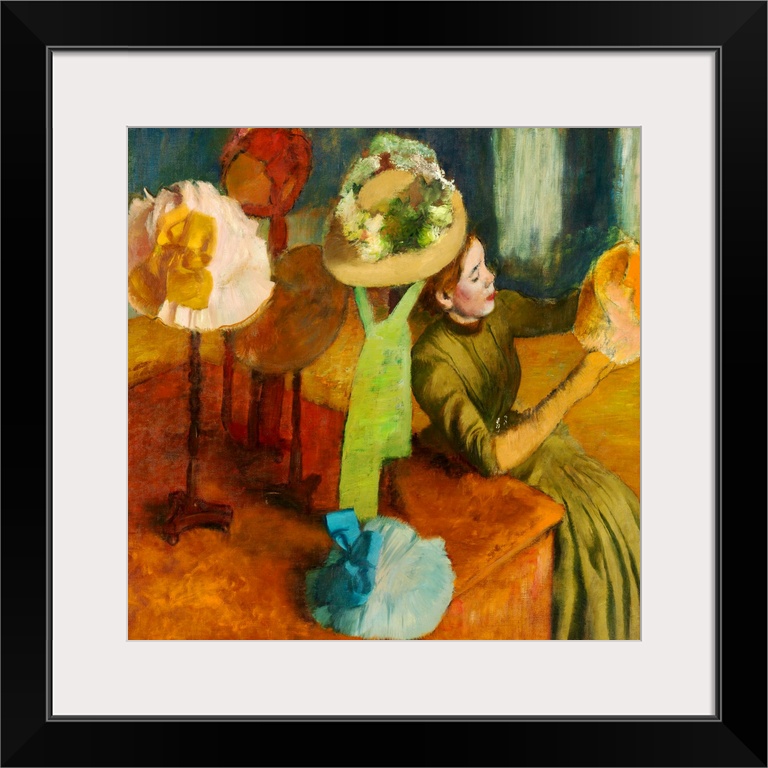




Showcase your favorite artwork in a contemporary, handcrafted framed art print. These premium and timeless frames are sure to work with any decor or style of art. With multiple handcrafted frame styles to choose from, we’re confident you’ll find the perfect frame for your new fine art selection.
<p>Each piece of <a href="/category/all/?product=15&sort=age-asc">framed art is printed</a> with UV-resistant, archival latex inks to ensure color accuracy, image clarity, and long-lasting print quality. Our giclée art prints are reproduced in vivid detail on premium fine art paper for a high quality reproduction.</p>
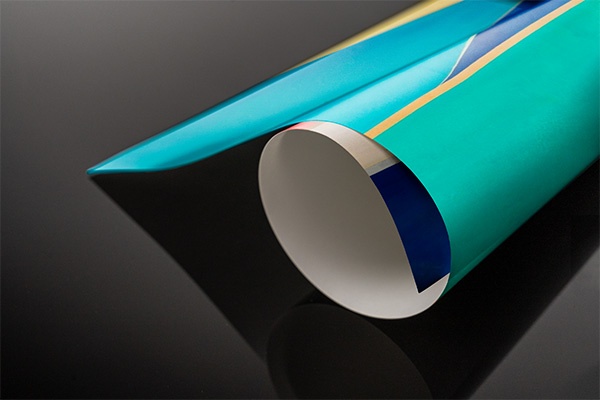
<p>Our framed art prints come in a multitude of beautiful finishes. Each handcrafted wooden frame is available in a range of colors and finishes to pair with any art or decor style.</p>

<p>Each framed art print is printed and assembled by hand in the USA by our team of skilled craftspeople. Our framed prints include a classic single picture frame mat, a protective acrylic glazing, a finished dust cover back, and premium hanging hardware.</p>

<p>Start enjoying your framed art print sooner with our preinstalled hanging hardware. All framed prints include D-ring and wire hanger.</p>
 Art
Classic Art
Classic Art by Period
Modern Art
Impressionism
Classic Art by Subject
Figurative
Edgar Degas
Fashion And Beauty
Hats
Orange Wall Art
Painting
People
Figurative
Art
Classic Art
Classic Art by Period
Modern Art
Impressionism
Classic Art by Subject
Figurative
Edgar Degas
Fashion And Beauty
Hats
Orange Wall Art
Painting
People
Figurative

